Wednesday, March 8, 2017

CBCP saddened by passage of death penalty bill at lower house

CBCP saddened by passage of death penalty bill at lower house
By Ferdinand G. Patinio


MANILA, March 7 (PNA) -- The Catholic Bishops' Conference of the Philippines (CBCP) is standing firm on its opposition to the death penalty.

In a statement, CBCP president Archbishop Socrates Villegas said they were saddened by the decision of the House of Representatives to approve on third and final reading the bill reviving the death penalty.

"The House of Representatives has given its consent for the State to kill. We, your bishops, are overcome with grief but we are not defeated, nor shall we be silenced," he said.

"In the midst of Lent, we prepare to celebrate the triumph of Life over Death, and while we grieve that the Lower House has voted for death, our faith assures us that Life will triumph."

At the same time, Villegas urged Filipinos to continue to express their opposition to the proposed measure.

"We call on all Catholic faithful and all Filipinos who stand for life to continue the spirited opposition to the death penalty," he said.

He likewise called on the judiciary to support the Gospel of Life.

"We urge Catholic lawyers, judges and jurists to allow the gentleness of the Gospel of Life to illumine their reading and application of the law, so that their service to society as teachers and agents of the law and of justice may bring life," the CBCP chief said.

On Tuesday, 216 members of the House said 'yes' to the reimposition of the capital punishment, while 54 lawmakers said 'no' and one abstained. (PNA)

Philippine Army to acquire force protection equipment, sniper rifles

SBMS still on go but PA to acquire force protection equipment, sniper rifles first
By Priam F. Nepomuceno


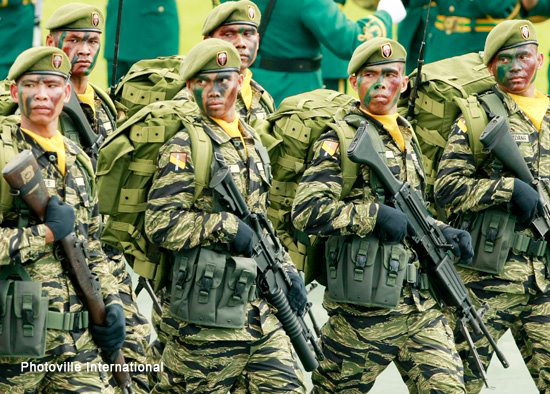
MANILA, March 7 (PNA) --- Acquisition of the country's shore-base missile system (SBMS) is still on go but the Philippine Army (PA) will first prioritize the procurement of additional force protection equipment, sniper rifles and first-aid kits for its troopers.

This was disclosed by PA commander Lt. Gen. Glorioso Miranda in a recent interview

"(We are looking and evaluating the possible SBMS) design, however in the manner of how we implement it (acquisition), it has to conform, say for example with the requirement of the current operational environment, like now, we are prioritizing (the acquisition) of equipment for the welfare and benefit of our soldiers like force protection equipment, (ballistic) helmets to increase their survivability and we are also investing in training to make them more proficient (in combat)," he said in Filipino.

"The SBMS remains on the list but I don't see that it is necessary for us to procure it in the meantime," Miranda said.

Other needs of the troops being acquired right now are sniper rifles, first-aid kits.

Miranda said the PA would proceed on acquiring its big-time ticket items when the proper time comes.

In 2015, then Armed Forces of the Philippines chief-of-staff Gen. Hernando DCA Iriberri requested the Php 6.5- billion SBMS project to be moved to the AFP Modernization Program Second Horizon as the more pressing needs then was the acquisition of force protection equipment, sniper rifles and radioes.

The SBMS will be acquired to beef up the external defense capabilities of the PA and not aimed at any particular nation.

The SBMS consists of 12 launchers, trailers and tracking systems and missiles that could be fired to neutralize ground and naval targets.

And in its place, force protection equipment, squad designated rifles and modern radios.

The AFP's Modernization Program is divided into three horizons, with the first lasting from 2013 to 2017, the second from 2018 to 2022 and third 2023 to 2028. (PNA)

Sec. Perfecto Yasay denies lying about citizenship

Yasay denies lying about citizenship
By Azer N. Parrocha


MANILA, March 7 (PNA) -- Foreign Affairs Secretary Perfecto Yasay Jr. on Tuesday said that he never lied to the Commission on Appointments (CA) about his citizenship.

"I would like to assure everyone that I have never lied in my testimony and I will continue and reiterate all the same statements that I made," Yasay told reporters in an interview.

Yasay admitted having a naturalization certificate which he "returned to authorities."

To recall, his confirmation was suspended due to pending concerns of some congressmen about his reported US citizenship.

During his CA confirmation last Feb 22, Yasay said that although he applied for a US citizenship, his application was denied which is contrary to the documents that stated that he did possess a US citizenship.

In a previous TV interview, Yasay admitted owning a US passport but returned it with his naturalization certificate.

Yasay, meanwhile, expressed hope that the CA would be fair during his next confirmation hearing on Wednesday (March 8, 2017).

"I would hope that everyone would be fair in not accusing me of lying because I never lied," he said.

He was in the Senate a day before his confirmation to speak to Sen. Loren Legarda on matters regarding "climate change." (PNA)

Tuesday, March 7, 2017

PNP-IAS starts probe of cops allegedly linked to DDS

PNP-IAS starts probe of cops allegedly linked to DDS

MANILA, March 7 (PNA) -- The Philippine National Police Internal Affairs Service (PNP-IAS) has started its fact-finding investigation into policemen allegedly involved in the so-called Davao Death Squad (DDS).

During the Senate hearing on Monday, Senior Police Officer 3 (retired) Arthur Lascanas named some police officers who were allegedly involved in the DDS.

Lascanas linked to the DDS PNP chief Director General Ronald "Bato" Dela Rosa, as well as other active police officers such as Senior Supt. Rommel Mitra, chief of the Directorial Staff of Police Regional Office-3 (Central Luzon); SPO1 Jim Tan and a certain Supt. Rivera.

PNP-IAS chief Director Leo Angelo Leuterio on Tuesday said they are currently validating the information revealed by Lascanas to the senators during yesterday's Senate hearing.

Leuterio said this is the first time the PNP has heard about the allegations of the self-confessed DDS member (Lascanas), so the information could not be classified as intelligence data.

He added that at the moment they still do not have the signed copies of Lascanas' sworn statement, and that they are only working with photocopies of unsigned documents.

Likewise, the PNP-IAS warned they will spare no one, not even the PNP chief (Dela Rosa), if the information provided by Lascanas is proven to be true. (PNA)
LGI/PTR/EDS

Philippine Death Penalty Law is Approved by Congress

Philippine Death Penalty Law is Approved by Congress
By Filane Mikee Cervantes

MANILA, March 7 (PNA) -- The House of Representatives on Tuesday approved on third and final reading the contentious measure restoring the death penalty.

Out of the 292 lawmakers, 217 voted in favor of House Bill No. 4727--or an act imposing the death penalty on drug-related crimes--while 54 congressmen were against its passage with one abstention.

Among the notable lawmakers who voted against the measure include Deputy Speaker and Pampanga Rep. Gloria Macapagal Arroyo, Ilocos Norte Rep. Imelda Marcos, Batangas Rep. Vilma Santos, Albay Rep. Edcel Lagman, Quezon City Rep. Kit Belmonte, and the seven-member Makabayan bloc, among others.

Speaker Pantaleon Alvarez said he would stand pat on his policy to replace members holding key posts in the House of Representatives if they voted against the contentious measure restoring the death penalty.

Before the nominal voting, Lagman raised the issue of unconstitutionality as the scheduled third reading approval of the death penalty bill on Tuesday violated the three-day notice rule prescribed in the 1987 Constitution.

Lagman was referring to Section 26(2) of Article VI of the Constitution, which provides that: "no bill passed by either House shall become a law unless it has passed three readings on separate days and printed copies thereof in its final form had been distributed to its Members three days before its passage, except when the President certifies to the necessity of its immediate enactment."

Majority Floor Leader Rodolfo Fariñas said the distribution of printed copies to congressmen's offices complied with the personal service rule.

Fariñas also stressed that the purpose of the three-day rule accords notice to congressmen that the measure would be taken up for third reading.

The bill seeks to repeal Republic Act 9346 that prohibits the imposition of death penalty in the Philippines. It also seeks to further amend the Revised Penal Code and the Comprehensive Dangerous Drugs Act of 2002.

Under the bill, the mode of capital punishment could either be through hanging, by firing squad or lethal injection.

The new version limits the crimes punishable by death to only drug-related offenses in a bid to strengthen the Duterte administration's relentless war on drugs.

The bill said the penalty of life imprisonment to death and a fine ranging from Php 500,000 to Php 10 million shall be imposed upon any person involved in any of the following acts:

- importation of dangerous drugs and/or controlled precursors and essential chemicals;

- sale, trading, administration, dispensation, delivery, distribution and transportation of dangerous drugs and/or controlled precursor and essential chemicals;

- maintenance of a den, dive or resort where any dangerous drug is used or sold in any form;

- manufacture of dangerous drugs and/or controlled precursors and essential chemical;

- qualifying aggravating circumstances in the commission of a crime by an offender under the influence of dangerous drugs;

- criminal liability of a public officer or employee for misappropriation, misapplication or failure to account for the confiscated, seized and/or surrendered dangerous drugs;

- criminal liability for planting evidence.

Meanwhile, possession of illegal drugs will be meted the penalty of reclusion perpetua or life imprisonment.

The bill said the death penalty will not be imposed when the guilty person is below 18 years of age at the time of the commission of the crime, or is more than 70 years of age.

The measure also requires the Public Attorney's Office and the Office of the Solicitor General to create a special panel composed of senior lawyers to handle the automatic review or appealed cases of the death penalty.

The bill said another amendment requires the public prosecutor to furnish copies of case information to the Commission on Human Rights (CHR), the Integrated Bar of the Philippines (IBP), the Free Legal Assistance Group (FLAG), and other religious and civic organizations.

Capital punishment was last suspended in 2006 by former President Gloria Macapagal-Arroyo.

President Rodrigo Duterte, however, has called for the passage of the measure to stop the proliferation of drugs and criminality. (PNA)

Philippines preparing for La Niña

Palace: PHL preparing for La Niña
By Leslie D. Venzon
Malacanang on Wednesday assured that a government program is in place to deal with the impacts of the La Niña weather phenomenon.

Presidential Communications Operations Office (PCOO) Secretary Herminio Coloma Jr. said it is implementing a comprehensive program on mitigating its harmful effects as part of the country's overall strategy on climate change resiliency.

"This covers agriculture, flood control and disaster risk reduction measures at the grassroots level," he said.

In the Philippines, La Niña is associated with anomalies in rainfall, temperature and tropical cyclone activities. (PNA) 

More women needed in Philippine police force, top gov't posts

More women needed in police force, top gov't posts

MANILA - The military, police force and other policy-making bodies need more women, Sen. Juan Edgardo Angara said Tuesday urging the government to intensify programs that promote the participation and equitable representation of women.

"We call on all government agencies to take proactive steps to capacitate women employees to strengthen their qualifications and performance to compete for third-level positions," Angara said.

"Competence and work experience should be main considerations for promotions and top positions, not gender," he added.

Angara made this call noting that data from the Philippine Military Academy (PMA) showed that the number of female cadets is limited to not more than 5 percent.

The senator also congratulated Cadet First Class Rovi Martinez who topped this year's PMA graduating cadets, and the other seven female cadets who landed in the top 10.

"They are proof that it is not only men who can excel in this. That is why we should make sure that we give equal opportunities to serve military," Angara said.

Data from the Philippine National Police (PNP) showed that female police officers compose 18 percent or 25,862 of the 168,897 police personnel.

Meanwhile, data from the Civil Service Commission showed that while there are more female than male of the total 1.86 million government workforce, the men still outnumber the women in top level or decision-making positions.

Of the 2,013 top level positions, 1,135 slots or 56 percent are filled by male while 878 or 44 percent are female. The top or third level positions include the Undersecretary, Assistant Secretary, Bureau Director, Assistant Bureau Director, Regional Director, Assistant Regional Director, Chief of Department Service and other officers of equivalent rank, all of whom are appointed by the President.

Angara, during his days in the Lower House, was one of the authors of the Magna Carta of Women or Republic Act 9710 that seeks to eliminate discrimination by recognizing and protecting the rights of Filipinas.

In celebration of National Women's Month, he noted a provision in the Magna Carta's implementing rules and regulations that seeks to increase the quota to 20 percent for female admission into schools and institutions in the military and police.

The Magna Carta further states that women in the military and police force shall be accorded the same promotional privileges and opportunities as men, including pay increases, additional remunerations and benefits, and awards based on their competency and quality of performance.

Apart from equal employment opportunities, Angara stressed that the Magna Carta of Women mandates the government to ensure that women are provided with equal access to formal sources of credit and capital, equal share to the produce of farms and aquatic resources, livelihood opportunities for returning women migrant workers through entrepreneurship development, among others.

Angara said the number of women in third level or supervisory positions in government must be increased to achieve a 50-50 gender balance as mandated under RA 9710.

He said that it has been almost eight years since the comprehensive women's rights law was enacted and yet, gender gap in economic and political participation persists.

"Gains have definitely been made but there's still more that we can do to finally close this gap and fully realize women's role as agents and beneficiaries of development," Angara said.(PNA)

Senator Cayetano calls out "inconsistent points" in Lascanas affidavit

Senator Cayetano calls out "inconsistent points" in Lascanas affidavit


Senator Alan Peter Cayetano on Monday (March 6) drew attention to the inconsistencies in the affidavit of retired policeman and alleged Davao Death Squad (DDS) member Arthur Lascañas, expressing further doubt over his credibility as a witness.


During the Senate inquiry into accusations of extrajudicial killings against the President, Cayetano asked Lascañas to clarify inconsistencies in his affidavit and statement regarding the  formation of a Davao task force in 1988 and the killing of former constabulary soldier Jun Bersabal.


The senator criticized Lascañas for making the statements based solely on his own assumptions.


He first pointed out the establishment of an Anti-Crime Task Force in 1988. According to Lascañas' testimony, the group was originally formed to target drug personalities and other criminals in Davao. Soon after, then Mayor Duterte would order the group to go after his personal enemies, he said.


Cayetano questioned how the witness could have known about the group's operations in 1988 when, in fact, he was not even on duty as a police officer during that year. He was only reinstated in 1989.


"Are you telling half-truths or whole truths? [In your affidavit,] may conflict kaagad. Sabi niyo, 1988 binuo ang liquidation squad. Pero 1989 pa kayo nakabalik ng serbisyo, so hindi niyo alam ang nangyari sa task force na ito noong 1988," he stressed.


"Ang affidavit niyo po ay hindi galing sa personal knowledge niyo… How can you say there was a liquidation squad if you weren't a part of it," he added.


Lascañas in response said his statement regarding the earlier operations of the group was based on his own assumptions.


"Assumption is not personal knowledge. It is not even hearsay," Cayetano intoned.


The senator further noted another discrepancy in the witness' testimony regarding the murder of Jun Bersabal, a former Philippine Constabulary member allegedly involved in the illegal drug trade.


In his affidavit, Lascañas narrated that they were ordered to arrest and murder Bersabal in 1993. The former constabulary soldier, however, was killed in 1997. 


"Bakit sa affidavit niyo, 1993 ang nilagay niyo? Paragraph 41, 'in or about 1993 I was instructed by Mayor Duterte to capture Jun Bersabal.' Hindi naman natin pwedeng sabihin na clerical [error] kapag ganito," Cayetano said.


The senator surmised that the reason behind the inconsistencies of Lascañas' statements was because he was being coached by some personalities who could be plotting to oust the President.


"In your case ho ba, Sir, may nag-coach din po ba sa inyo," he asked Lascañas.

1 in 20 PNP police ops producing “casualties” not “highly irregular”

Cayetano says 1 in 20 police ops producing "casualties" not "highly irregular"


Senator Alan Peter Cayetano on Monday (March 6) criticized retired policeman and alleged DDS member Arthur Lascañas for speaking about the effectivity of the current anti-drug war while admitting that he does not have the expertise and experience in conducting national operations.


Lascañas, during the Senate public inquiry, said that based on his experience in Davao, there were casualties in almost every anti-drug operation that they carried out.


"Around the world po, sa police, nakikita nyo rin naman sa Amerika, sa pulis may lumalaban din at bumabaril din kapag sa droga. Bakit niyo sasabihin sa Pilipinas, halos walang lumalaban," Cayetano pointed out.


"Sabi niyo po kanina, halos lahat ng operation, kailangan may patay. Ganoon po ang tema ninyo kanina," the senator said during his interpellation of Lascañas.


Cayetano cited PNP records showing that around 1 out of 20 police operations or only five percent of the total operations have produced casualties. It is not highly irregular contrary to what human rights critics are saying, he stressed.


Since July 1, 2016 to January of this year, there had been 43,593 anti-illegal drug operations conducted by the PNP. In total, 2,555 drug suspects were killed in these legitimate operations.


"Kapag laban kay President Duterte, kapag laban sa kanyang anti-drug war, may sagot na kayo kaagad na hindi effective," Cayetano said.


"One out of 20 lang ang may patay. Five percent. So yung pinapalabas na lahat ng operation may patay… hindi totoo iyon because of the 43,593 operations, only 2,555 [had casualties]," he added.


Cayetano also pointed out that since President Duterte assumed office, the government's anti-drug operations had intensified.


He cited that from January 2010 to June 2016, there were only 93,197 operations overall. "In six months alone of the Duterte administration, there were 43,593. Kalahati na po sa six months pa lang," he cited.


PNP meanwhile assured the Senate Committee that they are already conducting investigations on possible abuses of their personnel during operations. According to PNP-Internal Affairs Services, out of the 1,785 police operations they have been investigating since July 2016, 1,123 personnel have been asked to account for their actions while 851 face pending investigations.

Sunday, March 5, 2017

Philippines wants to enhance bilateral talks with China, says DFA think-tank

PHL wants to enhance bilateral talks with China, says DFA think-tank
By Sammy F. Martin

MANILA, March 4 (PNA) -- The think- tank of the Department of Foreign Affairs (DFA) said Philippines and China are concentrated in enhancing bilateral talks to promote trade, investment and security.

This was cleared by Edgar Badajos, director for ASEAN Political Security of DFA during the of Seminar on ASEAN sponsored by the Presidential Communications Operations Officeat DFA Friday.

"The Philippines is more interested enhancing bilateral talks with China and not the issue of findings of Arbitral Tribunal," he said. "We need to strengthen first our relations with China and we will touch the issue in a proper forum."

He explained that "we are not abandoning of our claims based on arbitral tribunal ruling" but this is not the right time to talk on this issue.

Badajos pointed out that we need to look for an avenue that will accelerate bilateral talks and not insinuate something that will trigger disputes.

While Foreign Affairs Secretary Perfecto Yasay Jr. emerged strong with his remark that China should demilitarize in the disputed South China Sea, a senior official of a Washington-based think tank group said it's likely impossible for Beijing to dismantle its installed weapon systems in the area.

Even experts on US-ASEAN Relations :Charting the next 40 Years," CSIS Southeast Asia program senior adviser Ernest Bower said "China is not going to walk that back just because they are asked to do it by a group of ASEAN foreign ministers."

In a press conference Thursday', Bower said during the closing reception of the Center for Strategic and International Studies (CSIS) international conference at the Manila Golf and Country Club in Makati City said, he did not believe the dismantling of military weapons system in the South China Sea would happen.

He said free navigation on international waters of disputed islands was what they were after.

Yasay earlier said some foreign ministers from the Association of Southeast Asian Nations (ASEAN) had expressed "grave concerns" over China's militarization in the region.

Bower said Yasay's response was correct, but it did not follow that China would readily comply."I think it's the right answer but I don't know, it doesn't seem very likely," he noted. (PNA)